GEO & SEO in Cybersecurity: What's Working for Cyber Brands in 2026
.png)
A full recap of the Cybersecurity Marketing Society webinar featuring Scott Johnson and Britani Losoya of Amplifyed, an SEO & GEO agency that specializes in the cybersecurity industry
GEO & SEO in Cybersecurity: What's Working for Cyber Brands in 2026
If you missed our April 30th webinar (or just want a reference you can bookmark and revisit) you're in the right place. Scott Johnson (President) and Britani Losoya of Amplifyed, an SEO/GEO agency that works exclusively with cybersecurity companies, spent an hour going deep on what's actually moving the SEO and GEO needle for cyber brands in 2026. They covered the theory, showed live examples using real Society member websites, and answered every question the community threw at them.
This recap will include everything they covered on the webinar - many thanks to Scott, Britani, and Amplifyed for providing us with these insights to make cybersecurity GEO and SEO better!
First: What Is GEO, Actually?
Before getting into tactics, Scott cleared up the terminology confusion that's been floating around.
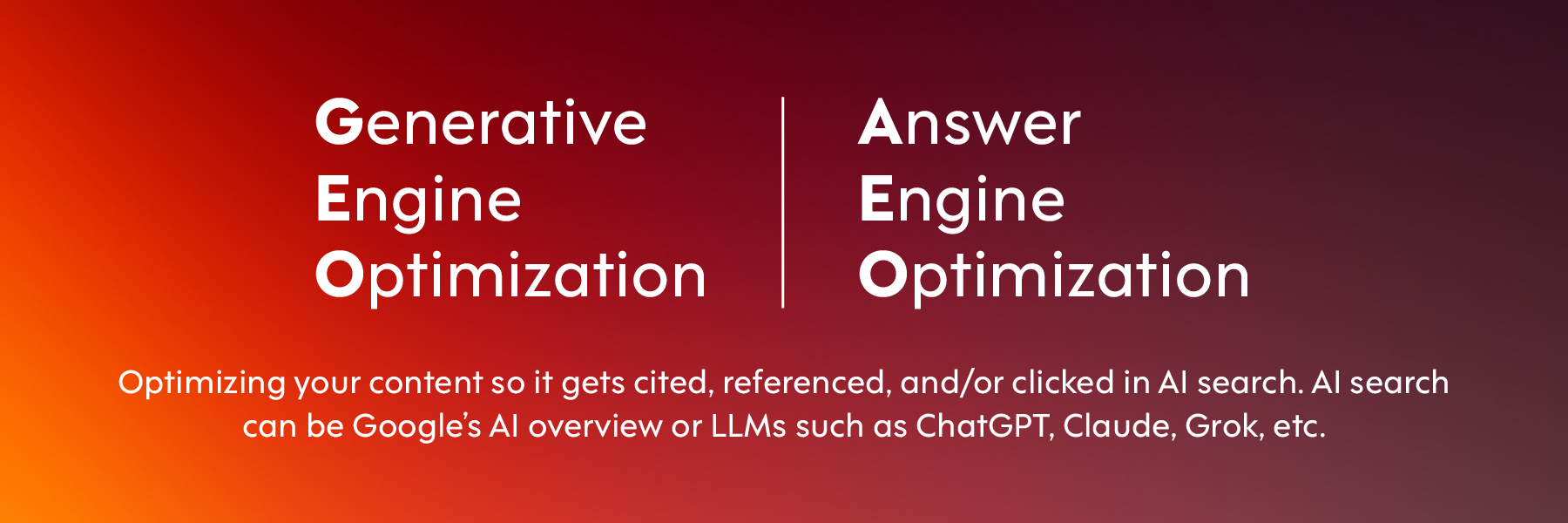
GEO stands for Generative Engine Optimization: optimizing your content so it gets cited, referenced, and/or clicked in AI search. "AI search" includes Google's AI Overviews, but also LLMs like ChatGPT, Claude, Grok, and others.
You may also hear the term AEO (Answer Engine Optimization): same concept, different acronym.
And Scott had a plea for the group: can we please agree to never use the newest acronym dujour: HEO (Hybrid Engine Optimization)? The chat roared in agreement.
Referenced vs. Cited vs. Clicked
There are three ways your brand can show up in an AI response, and understanding the difference matters:
- Referenced: The AI names your company in its answer. An example is someone searched for CTEM providers, and Claude listed you by name. This is brand visibility gold!
- Cited: The information in the AI's response is being pulled directly from your content. Your site is the source and is clickable. AI considers your website a “source-worthy” site!
- Clicked: The user actually clicks through to your website from the AI result, landing on your website.
The holy grail is all three at once: referenced, cited, and clicked. But even just being referenced is a meaningful win for your brand.

Why AI Search Matters More Than the Volume Suggests
The numbers on daily searches tell an important story: Google still dominates at roughly 14 billion searches per day, while ChatGPT handles around 2.5 billion. So why should cybersecurity marketers care so much about the smaller channel?
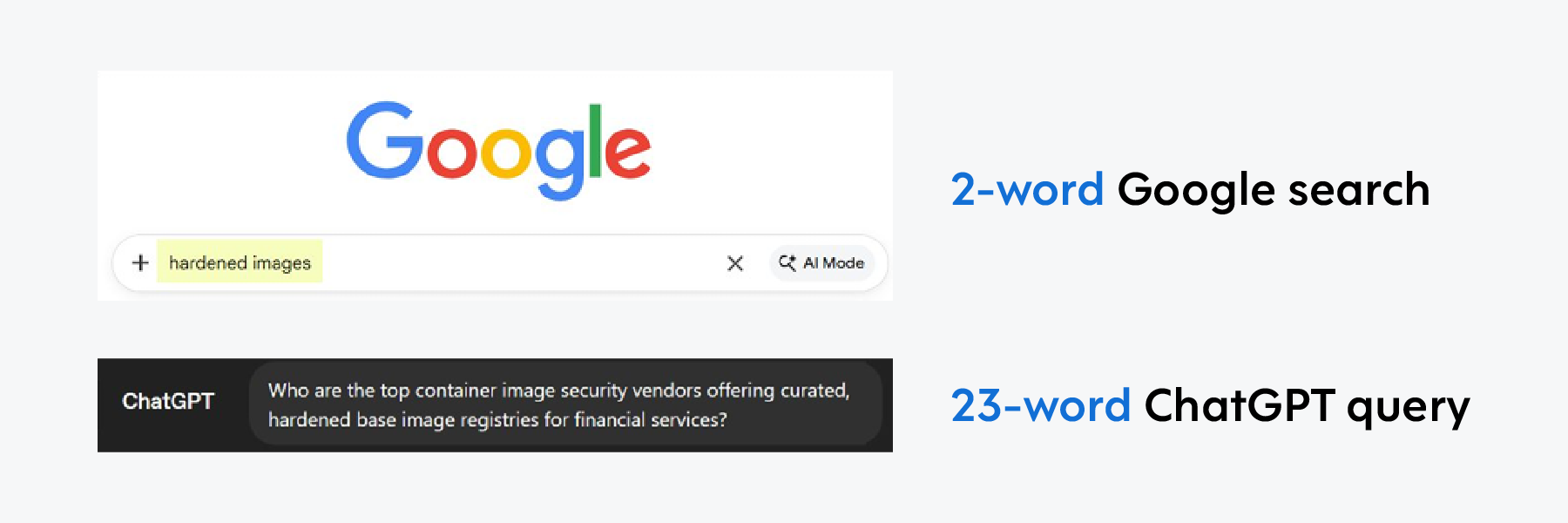
Query intent. This stat says it all: 51% of Google searches are just 1-2 words long. The average ChatGPT search is 23 words long.

Scott illustrated the difference with a great example. In Google, someone might search: "hardened images."
In ChatGPT, that same searcher might ask: "Who are the top container image security vendors offering curated, hardened base image registries for financial services?"
Which lead would you rather have? The long-form AI query tells you the industry, the use case, the buyer's level of sophistication, and what they're actually looking to buy. When AI cites you in response to that kind of query and the user clicks through, they land on your website already problem aware and are more likely to be searching for a solution.
A few other notes on the LLM landscape:
- Claude is closing the gap on ChatGPT fast: the audience gap may have narrowed by roughly half just this year.
- ChatGPT's user base skews 30s-50s; Claude's skews 20s-30s.
- Don't obsess over optimizing for one specific LLM. GEO tactics tend to work across platforms, so targeting them simultaneously is the right move.
GEO vs. SEO: Not a New Discipline…An Additional Layer!
One of the most clarifying frames Scott offered: GEO is not a new discipline to master separately from SEO. It's an additional layer on top of it.
The two are deeply intertwined. In fact, here's a stat from the webinar that drives the point home: 52% of sources mentioned in Google AI Overviews rank in the top 10 organic Google results. AI search largely trusts what Google already trusts. If you're not ranking organically, it's extremely hard to show up in AI.
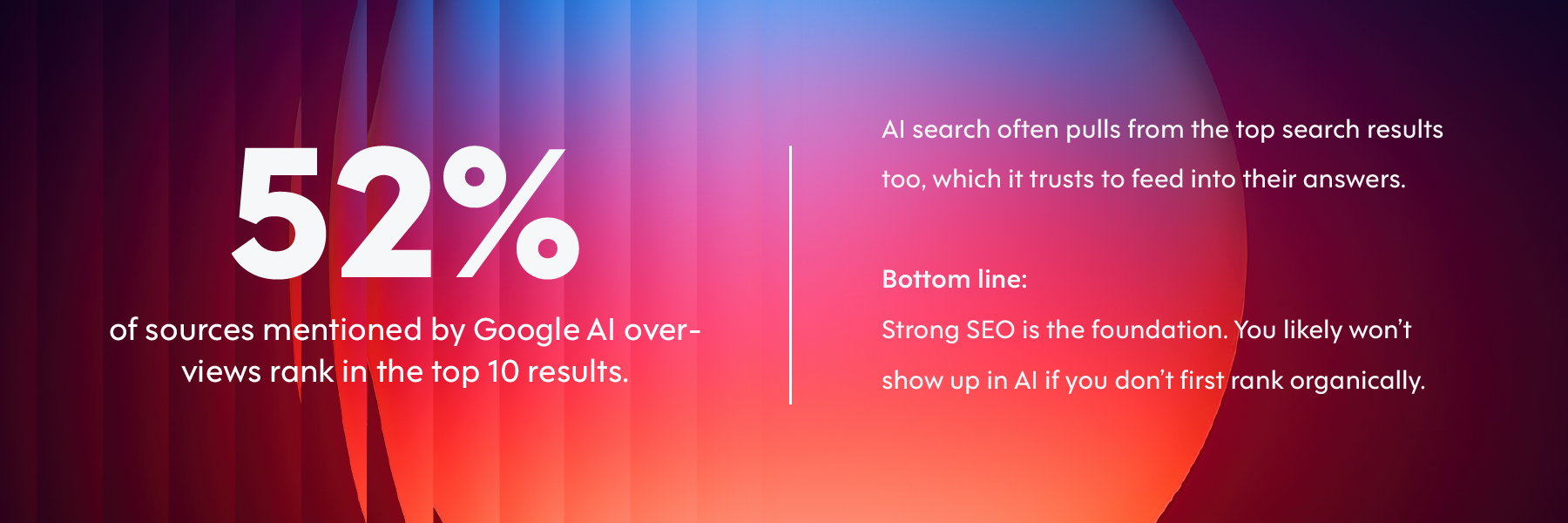
The practical implication: strong SEO is the foundation. You can work on both simultaneously, but you cannot skip the SEO foundation and expect GEO to carry you.
One comment on speed that Scott highlighted: GEO moves faster than SEO.
Traditional SEO can take months to show results in a competitive space. GEO results can shift in weeks, sometimes days (we’re not sure yet about minutes!). Scott compared it to the early days of SEO when rankings moved quickly and the space wasn't yet saturated.
That window of opportunity exists right now for cybersecurity brands willing to invest in this domain.
How to Track AI Visibility (The Honest Attribution Answer)
Scott was upfront about the measurement challenge: most people don't click links in AI results, which makes traditional attribution messy. Someone might see your brand mentioned in a ChatGPT response, close the window, and Google you directly. That visit looks organic but was driven by AI. You won't know it.
(Kind of like our ever-ongoing marketing attribution challenge… a prospect visits a website and doesn’t submit their email, then they see your booth at a trade show, and then they hear your CEO speak on a podcast… some things are not trackable!)
The best proxy metric right now? Brand mentions. Track how often your brand shows up across AI responses, even when there's no click.
Several tools are available for this:
- Profound: well-regarded in the cyber space
- Otterly: another solid option
- Ahrefs / SEMrush: both have brand radar features; slightly less deep than the dedicated tools, but pairing one with a dedicated AI visibility tracker works well
When setting GEO KPIs for the quarter, Scott recommended brand mentions as a meaningful metric rather than something like "we want to rank #1 for this specific prompt." The latter is easy to engineer and doesn't reflect the broader brand visibility you actually want.

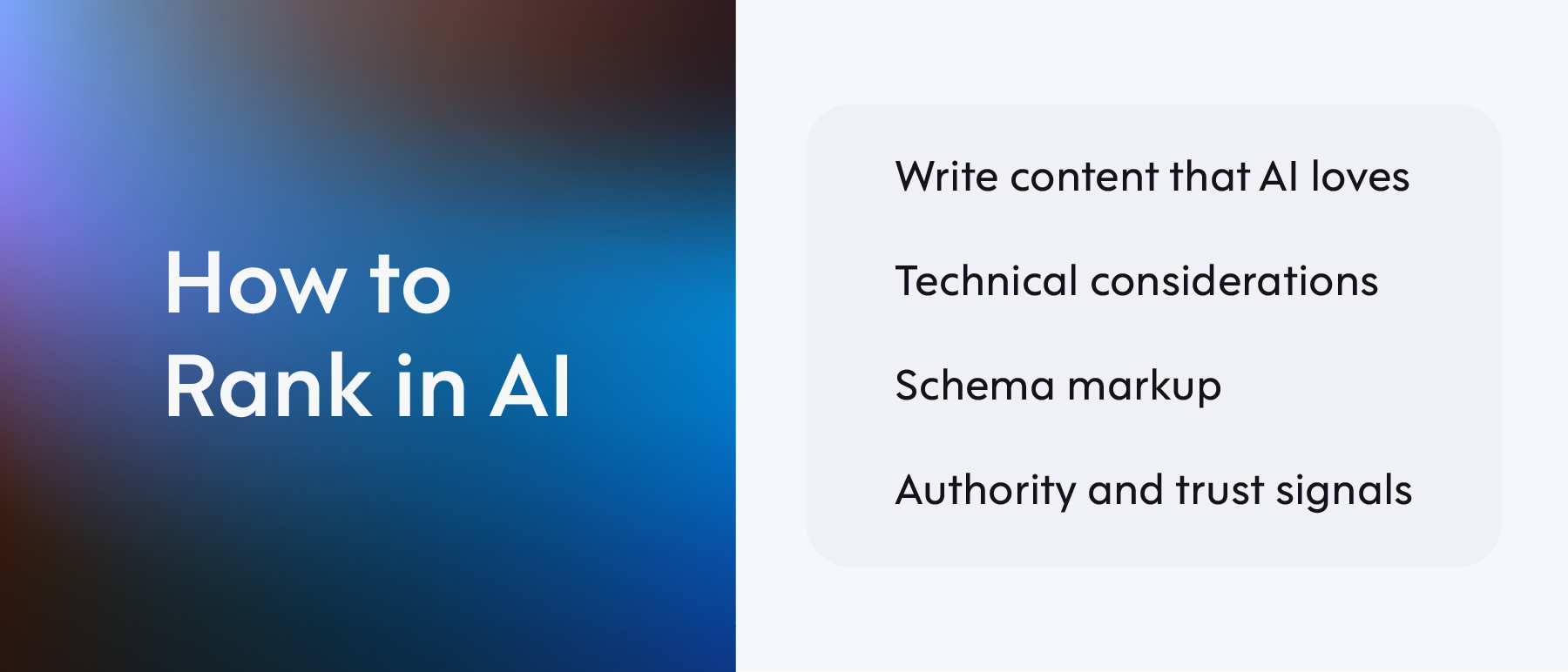
How to Rank in AI Search: The 4 Tactical Pillars
Scott and Britani organized their tactical guidance into four categories:
- Content that AI loves
- Technical SEO & GEO
- Schema markup
- Authority and trust signals
Pillar 1: Content That AI Loves
Refresh older content first
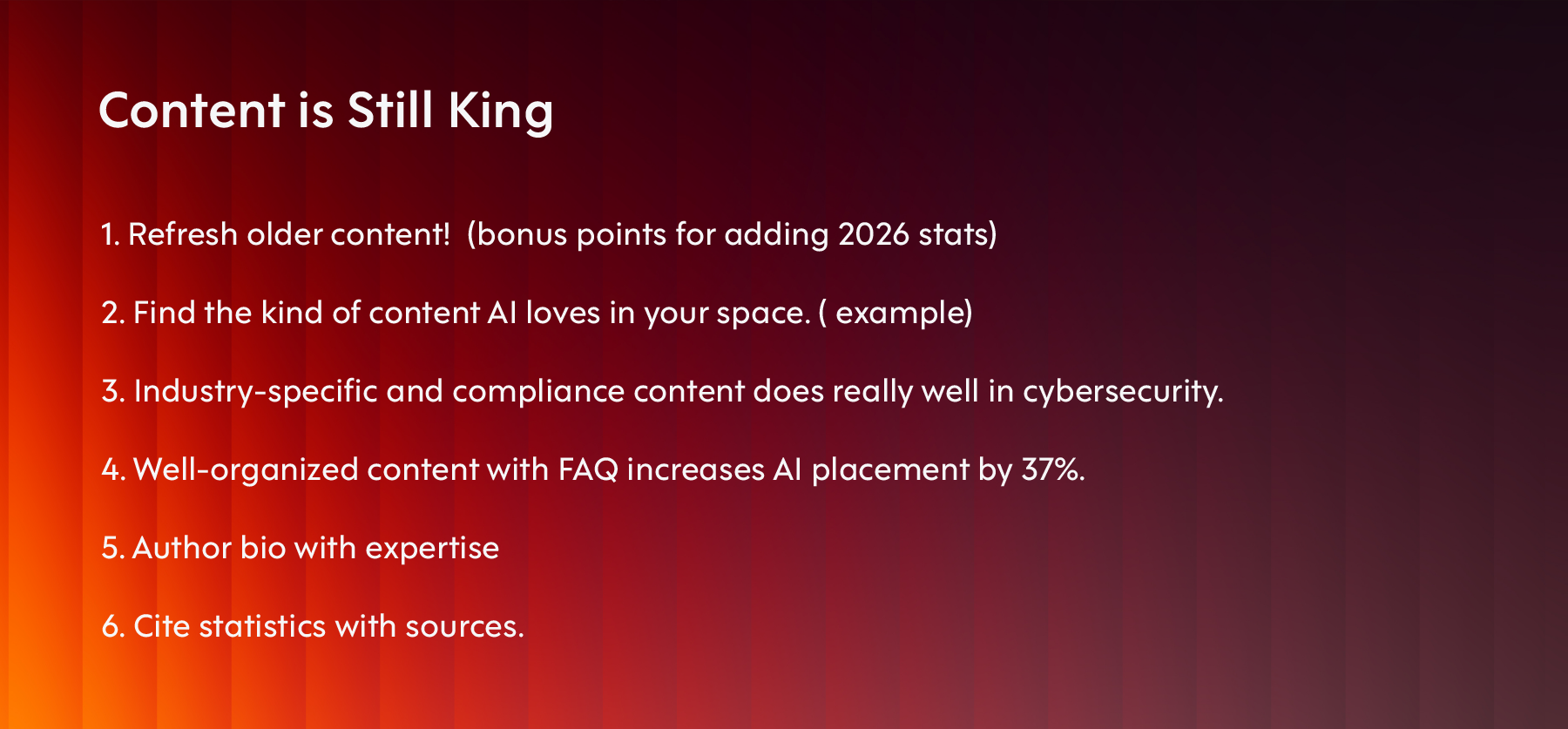
The number-one lever Amplifyed sees underutilized at cybersecurity companies is refreshing existing content. Most teams obsess over hitting a quota of new posts per month...but for faster lead generation, older content that already has some traction (or is tantalizingly close to page 1) is often the faster path.
How to find what to refresh:
- Look for pages currently stuck on page 2 of Google. They have momentum; they just need a push!
- Look for pages already driving traffic that could be further optimized.
One important caveat: just updating the publish date doesn't count. The algorithms know that trick! Add new 2026 stats, update examples, and expand sections. Make it substantively better.
Find the content types AI loves in your specific space
Rather than guessing whether you should be on Reddit, G2, or Gartner, Scott showed a method for discovering what content AI is actually pulling for your category of security solution.
Here's the exercise: Go to Claude (or ChatGPT) in an incognito window (important, otherwise it may have learned your company preferences) and search something like: "Who are the top [your category] providers and why?" Phrase it like a buyer would: use words like "vendors," "providers," "solutions."
Look at what gets cited. Are they third-party listicles? Analyst reports? Review platforms? The AI is showing you exactly the type of content it trusts for your space.
In the CTEM example Scott walked through, platforms like PeerSpot and websites like Terra Security appeared multiple times in the citations. That's a signal: reaching out to those websites hosting the listicles to get included (yes, sometimes - depending on the website - there's a cost involved) is money well spent if the alternative is your competitor telling the story about your category.
Industry-specific and compliance content
Scott called compliance content a "cheat code" for cybersecurity…and the chat on the live webinar lit up in agreement! Compliance still drives buying behavior in cybersecurity.
Compliance content (SOC 2, HIPAA, PCI DSS, etc, etc, etc...) is especially powerful because people searching for compliance solutions have a clear need and intent to buy.
Additionally, even if your platform is broadly applicable, creating content tailored to specific industries (fintech, healthcare, manufacturing) dramatically increases your chances of appearing when a buyer in that industry runs a very specific AI search. People search with their industry in the query, and when you have a page that speaks to their exact context, you get cited!
FAQ content drives a 37% increase in AI placement

Well-organized content with FAQ sections increases AI placement by 37%. The implementation is simple: add FAQs to your platform pages, feature pages, and blog posts.
One key nuance from Scott: write FAQs for humans, not for keyword density. The old-school SEO approach of awkward keyword stuffing (Q: "Are you the top CTEM provider?" A: "Yes, we are the top CTEM provider") actively hurts you. Write naturally. AI is excellent at understanding intent, and it rewards genuinely helpful content.
Also: don't have a general FAQ page anymore. That's outdated (and this tip was news to us here at the Cybersecurity Marketing Society!)
Put FAQs on the specific page where they're most relevant; integration questions on the integrations page, compliance questions on the compliance page, etc, etc!
Author bios with demonstrated expertise
This connects to Google's E-E-A-T framework (Experience, Expertise, Authoritativeness, Trustworthiness), which AI search also relies on. One of the most common things Scott sees on cybersecurity sites: the author of a blog post is listed as "the company name." That's a missed opportunity.
Every piece of content should have a real, named author, and that author's bio should explain why they're an expert on this topic. That can be a job title, a certification, years of experience in a specific area, or a relevant background. It builds trust with both human readers and AI crawlers.
(You’ll notice we just added author bios to the Cybersecurity Marketing Society website based on this advice!)
Cite statistics with sources
Citing external data like research reports, third-party studies signals credibility and trustworthiness. Even better: proprietary data from your own customer base. A stat like "65% of our customers reduced mean time to detect by X" is more powerful than citing someone else's research because it's unique to you and can't be replicated by competitors.
Downloadable: Your Blog Checklist
Scott shared this checklist and suggested everyone screenshot it. Every piece of content you publish should have:
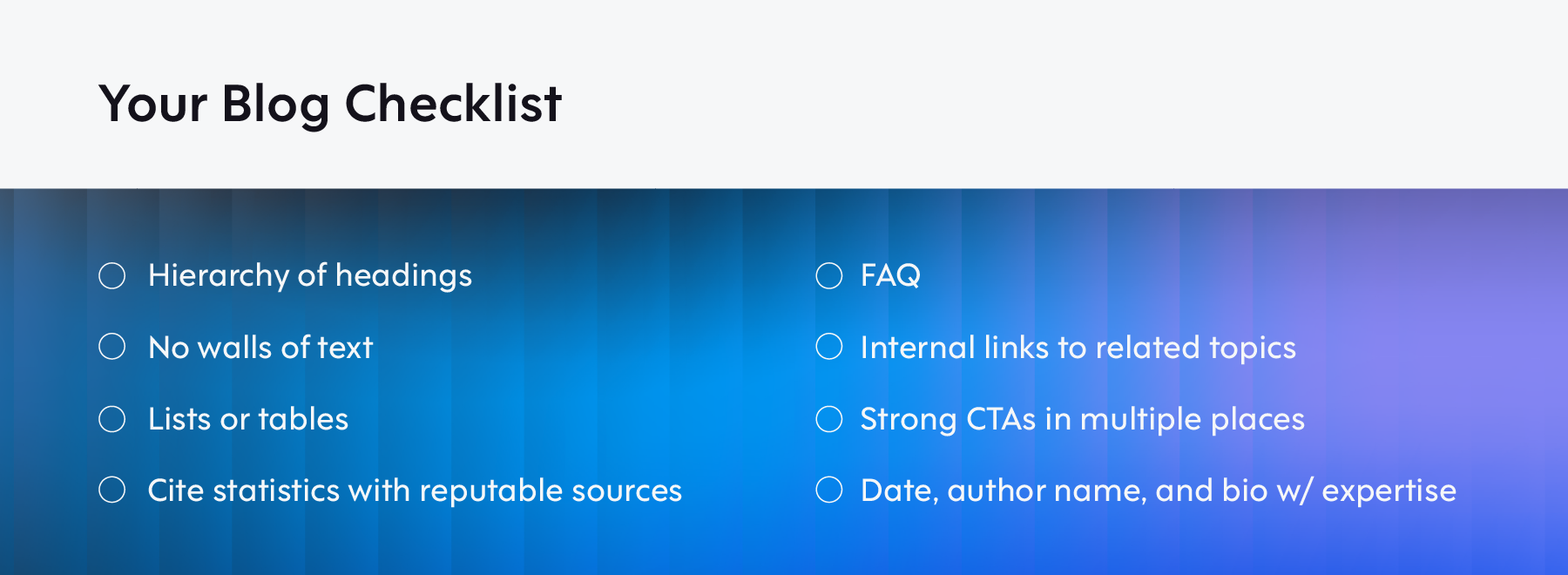
✅ Clear heading hierarchy (H1 for title, H2 for major sections, H3 for sub-sections)
✅ No walls of text — break it up
✅ Lists or tables (AI loves structured formats)
✅ Statistics cited with reputable sources
✅ FAQ section
✅ Internal links to related topics
✅ Strong CTAs in multiple places
✅ Date, author name, and author bio with demonstrated expertise
On CTAs: the more complex and expensive your sales cycle, the more you want to vary your conversion asks. Not every visitor is ready for a demo. Test softer CTAs: gated guides, video walkthroughs, email captures.
Scott mentioned one client who saw conversions go from 1.5% to 3.5% just by changing the CTA language from "Get a Demo" to "Experience the Platform."
Download the SEO & GEO Checklist
No need to screenshot this blog post. We've made a handy dandy downloadable! Fill in your email below to get The GEO SEO Checklist by Amplifyed and Cybersecurity Marketing Society!
Pillar 2: Topical Depth: The Concept That Changes Your Content Strategy
Topical depth is one of the most important concepts in modern SEO and GEO, and it's often misunderstood.
In the early days of SEO, a publication like Forbes could rank for "what is phishing" purely on the strength of its domain authority, even though it offers no phishing-related services and only marginal phishing-related content (I mean, some news, sure…but a lot of info on phishing? Not really). That's much less true today.
Algorithms increasingly reward topical authority: having deep, interconnected content across a specific subject area.
For a cybersecurity company offering email security, topical depth looks something like this:

- Product page
- Feature pages (phishing prevention, malware detection, account takeover protection, etc.)
- Case studies
- Annual/quarterly email security guide
- Industry alert content
- Glossary
- Platform-specific pages (Outlook security, Gmail security)
- Industry-specific pages (enterprise, healthcare, financial services)
- Attack-type pages (phishing, ransomware, account takeover)
Each page builds on the others. Glossary pages may not convert directly, but they signal topical authority that lifts all your other pages. The interconnected structure of content on a topic — linked together with smart internal linking — is exactly what AI crawlers are looking for.
Pillar 2: Technical SEO & GEO

Britani took over for the technical section, and her key message from the jump: small technical fixes create massive impact at scale. Flipping one setting can fix issues across hundreds of pages!
Indexing and Crawling: The Foundation
If AI can't find your site, it can't cite your site. The two things that control this:
- robots.txt - controls which bots are allowed to crawl your site
- noindex directives - controls what gets indexed
One wrong setting in either of these can make your entire website invisible to AI crawlers. Britani showed a stark example: the difference between Disallow: (empty = crawler is welcome) and Disallow: / (one slash = crawler is completely blocked) is literally one character. Cybersecurity companies regularly have this misconfiguration, often carried over from a dev environment.
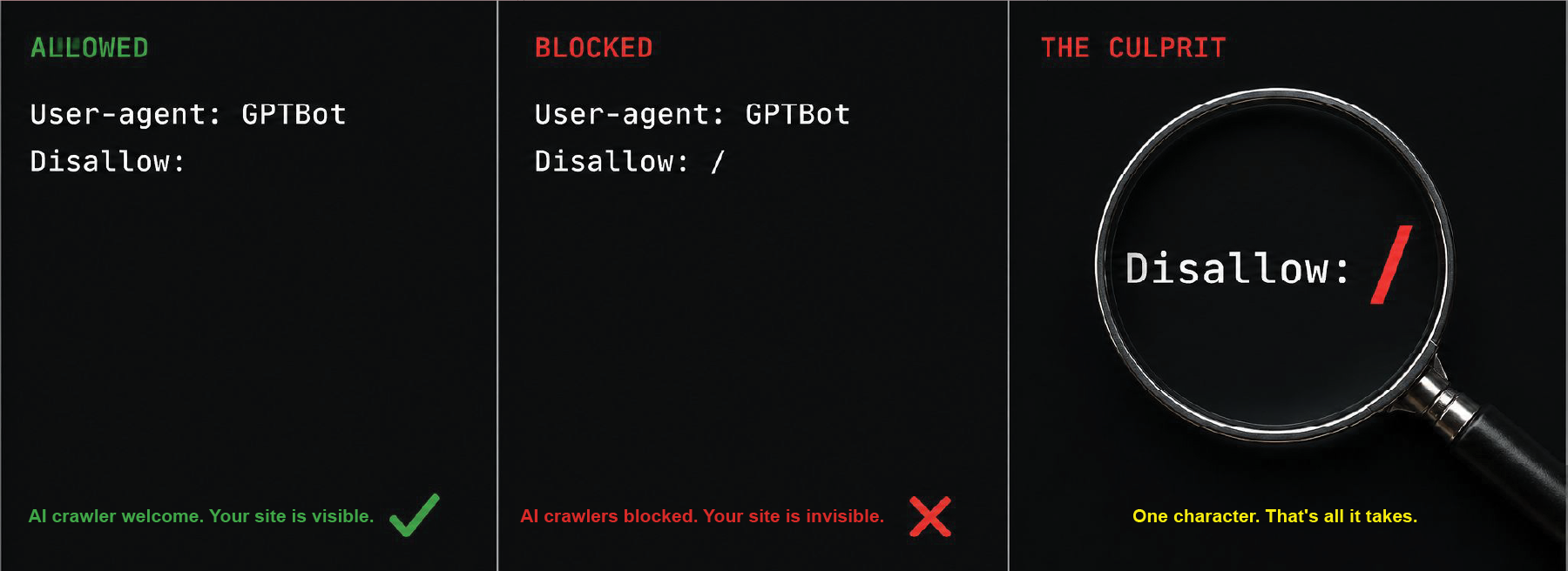
The flip side: you can also explicitly tell AI crawlers that they are welcome. An optimized robots.txt file has specific directives for each major AI user agent: GPTBot, ChatGPT-User, ClaudeBot, Claude-User, Claude-SearchBot, PerplexityBot, etc…explicitly allowing crawling and serving. This is something most sites haven't done yet, which means doing it now is a competitive advantage.

Practical tip: Check yours right now by going to yourwebsite.com/robots.txt.
If you've gone through a recent site migration, launched a new site, or made major dev changes, audit your indexing and robots.txt immediately.

Site Structure: The Organized Bookstore vs. Chaos
Britani used a great analogy: imagine you know exactly what book you want, but the bookstore shelves are completely disorganized, no genre labels, books everywhere. You'd either go somewhere else or pull out your phone and order it directly.
LLM crawlers behave the same way. When they hit your site, they're trying to understand what you do and surface the most relevant content for their users. If your site is hard to navigate, they'll move to a competitor's site that's better organized.

What structured sites do:
- Easy navigation = more pages get crawled
- Clear on-page content hierarchy = content gets correctly interpreted
- Internal linking = crawlers stay on your site and understand the full picture of your offerings
On internal linking: don't just think about it as an SEO technique. Think about it as guiding both humans and crawlers through your content toward a logical conclusion. As Scott mentioned earlier, link strategically: if someone's on a platform page, link to other conversion-focused pages, not back to top-of-funnel blog posts.
Site Speed: Non-Negotiable for GEO
Just like SEO is better when sites are fast, AI crawlers also won't wait for your site to load. Data shows LLMs prioritize fast-loading sites, and if your page takes more than roughly 1 second to load, it's likely to be skipped in favor of a faster competitor.

Site speed isn't just an item on a technical checklist; Britani recommended making it part of every conversation when new pages go live or major site updates happen.
Pillar 3: Schema Markup
Schema has been around for years in SEO, but it's taking on heightened importance for GEO. It's code injected into the backend of your site that speaks the "language" of AI and search engine crawlers, telling them what type of content is on a page before they even have to read it.

The schema types most impactful for cybersecurity companies:
- Organization schema: establishes who you are as a company
- Article schema: includes author, date, topic for blog and editorial content
- FAQ schema: supercharges the FAQ content you're already adding to pages
- SoftwareApplication schema: Britani's personal favorite for cyber clients; categorizes your product as security software, can include aggregate ratings and feature lists

The beauty of getting schema right: it compounds on top of all the other work. A well-indexed, fast-loading, structured site with schema is giving AI crawlers the absolute maximum signal at every level.
Britani's top recommendation for new websites: build schema programmatically from day one. Work with your developers to set it up so that every new page that gets published automatically receives appropriate schema.
Pillar 4: Authority & Trust Signals

Your content quality builds trust within your site. Authority signals build trust across the web. And AI pays attention to both!
Backlinks from relevant sources matter more than backlinks from high-traffic sources. Scott put it plainly: he'd rather have a link from a small cybersecurity blog with 200 monthly visitors than one from an unrelated high-traffic site. Relevance is the key variable.
The most valuable authority signals for cybersecurity brands:
- Quality backlinks from relevant cybersecurity publications, associations, and partners: when the Society linked to Amplifyed, Scott described popping champagne. That's how much relevant industry links matter! 😀PS: thanks Scott & Amplifyed, here’s another backlink for you 😉
- Inclusion in "best of" listicles: especially the ones AI is already pulling for your category (see the incognito research exercise above).
- Positive reviews on third-party platforms: G2, Gartner Peer Insights, PeerSpot, Capterra. These platforms are heavily cited by AI for software category searches.
- PR and unlinked brand mentions: this one surprises people. You don't need to be hyperlinked. If a credible source mentions your brand name in an article - even without a link - that brand mention registers with AI as a trust signal. Earned media and PR are more valuable than ever in a GEO world.
Scott's candid take on PR: "Our clients that have really good PR make us look like heroes. I'll put it that way."
Live Website Audits: Real Society Members Submit the GEO Audit!
Scott then did live. pre-screened audits of volunteer Society member websites. The specific companies don't matter as much as the patterns - because what he found applies to almost everyone!
Drata GEO Review by Amplifyed
What they did well: Author bios present and detailed = three thumbs up! Bolded lists in blog content are good.
Opportunities:
- Blog posts are very text-heavy with no conversion elements breaking up the content. Add inline CTAs, demo prompts, or content upgrades throughout.
- The only CTA on a blog page was a newsletter signup. Check whether that's actually converting - newsletters often don't perform as CTAs on blog pages. Bright, contrasting CTAs for demo or trial tend to outperform.
- Product/solution pages aren't using language that matches what buyers are actually searching for. A competitor (Vanta) is ranking 1-2-1-2 for terms like "compliance automation" that Drata isn't targeting on those pages. Keyword strategy on solution pages and the homepage would significantly elevate both SEO and GEO.
Qevlar GEO Review by Amplifyed
What they did well: FAQ sections present and written for humans. Reddit brand mentions found — unlinked brand mentions showing up organically, which is a great signal.
Opportunities:
- No schema markup anywhere on the site. This is a significant and fixable gap. Organization schema, FAQ schema, and SoftwareApplication schema would meaningfully improve GEO visibility.
- Demo CTA button is black, which blends into the site. Use a contrasting color (opposite on the color wheel) to make it stand out.
- Demo is a popup rather than a standalone page. Standalone demo pages convert better and get cited more by AI. Move the demo to its own page with a form, social proof (customer testimonials with faces and names), and focused copy.
- General FAQ page should be dissolved - questions should live on the most relevant specific pages instead.
- The site needs more overall traffic before GEO will fully take off, but the foundation is good and these fixes will accelerate things.
ProArch GEO Review by Amplifyed
What they did well: Site is fast. Extensive FAQ content across many pages - this is clearly paying dividends and is a great example of what other sites should be doing.
Opportunities:
- Remove the image slider on the homepage. CRO testing consistently shows that moving elements distract users and hurt conversions. Static, focused messaging converts better.
- "Contact" button shouldn't match the site's primary colors; use the opposite color on the wheel (orange, in their case) to make it pop.
- No schema. This keeps coming up because it's everywhere.
- Topical depth challenge: ProArch offers many services, which makes it hard to build deep authority in any one area. Scott's recommendation: apply the 80/20 rule. Identify the top two or three services driving most revenue. Pick one per month and build a full content hub around it: case studies, sub-feature pages, industry applications, blog posts, attack-type content. Build depth before breadth.
Audience Q&A: GEO & SEO Questions That Came Up
Questions came up throughout the webinar. Here’s the questions and Scott and Britani’s answers!
How important are LLMs.txt files? The community's getting mixed signals.
Answered by Britani: The honest answer is we don't have enough data yet to say they're driving material results. It's a proactive measure; it doesn't hurt to have one, and it may become more important as these platforms mature. Amplifyed recommends adding them as a "set yourself up for future success" move. But it's not a priority if you haven't nailed the fundamentals first.
If we have a forward slash in the Disallow section of our robots.txt, does that hurt AI crawling?
Answered by Britani: Not necessarily; it depends on which user agent you're issuing that directive to. Disallowing a / for GPTBot is catastrophic; disallowing /api/ or /private/ for everyone is intentional and fine. The key is being deliberate and checking each directive by user agent. If you're not sure, Amplifyed offered to check for free - just email them.
What tools do you recommend for auditing internal linking?
Answered by Britani: Screaming Frog is the go-to. Run it across your site, extract the internal linking data, and analyze from there.
When setting up a brand new website, what are the two most important things to nail for SEO/GEO?
Answered by Britani: First, site indexing! An alarming number of new sites launch with indexing turned off (carried over from the dev environment) and are invisible to every search engine from day one. Check this immediately. Second, schema; set it up programmatically so every page that publishes automatically receives appropriate schema. These two things done right from the start put you significantly ahead.
How does earned media and PR impact LLMs and AI results?
Answered by Scott: Hugely. PR is one of the biggest force multipliers on GEO work. And brand mentions don't even need to include a hyperlink to count as an authority signal…unlinked mentions on credible sources register with AI. Companies with strong PR programs make the SEO/GEO work move dramatically faster.
Our homepage gets a lot of traffic but very little of it goes to the demo page. What's the right approach?
Answered by Scott and Britani: A few things to investigate:
- Check the quality of the traffic. Are people landing on your homepage via searches that are actually relevant to your ICP? Very top-of-funnel or off-target traffic won't convert regardless of your CTA.
- Be crystal clear about what you do and why you're different in your homepage hero. "Cybersecurity solutions" isn't a hook. What makes you different from CrowdStrike or whoever the default choice is in your space? That specificity matters.
- Test your CTA language. "Get a Demo" is a commodity phrase. "Experience the Platform" or "See It in Action" may convert better — but you have to test. Tools like VWO let you A/B test CTAs. One client went from 1.56% to 3.5% conversion just from a CTA language change.
- Button color matters more than designers want to admit. Use the opposite color on the color wheel from your primary palette. Make the CTA button the only thing that color on the page.
- On the demo page itself: sell the demo, don't just label it. Use bullets to describe what they'll get from the meeting. Add a customer face and testimonial alongside the form. Conversions can double with this change alone.
- Capture the non-ready visitor. If someone hits your demo page and doesn't start filling out the form within 15 seconds, trigger a softer offer: "Not ready for a demo? Enter your email to watch a recorded walkthrough." You keep the lead.
Cybersecurity-Specific Strategies: The Full List

Here's the complete rundown of cybersecurity-specific GEO/SEO tactics Scott outlined:
- Feature pages for every feature of your platform: people search for features, not platforms. Meet them there.
- Industry-specific pages: even if your platform is industry-agnostic, pages targeting specific verticals dramatically improve AI citation for industry-specific searches.
- Compliance content: SOC 2, HIPAA, PCI, NIST, whatever applies to your buyers. It's a cheat code.
- Competitor comparison pages: don't let competitors tell the story of how they're different from you. Own that narrative. Search volume on "[Competitor] alternatives" is high, and those are some of your best-fit leads.
- Listicles for core target keywords: even if they're published by third parties. Get included in the ones AI is already pulling.
- Glossary pages: don't expect direct conversions, but they build topical authority that lifts all your other pages.
- Threat alert content: for larger companies especially, regularly updated content on current threats signals ongoing authority and freshness.
Conclusion: The Most Important Mindset Shift
Scott ended with a principle he's seen consistently separate the companies that get results from the ones that don't: perfection is the enemy of progress.
Content that waits 3 months for internal approvals doesn't generate leads. A website that spends 6 months in final polish while the existing site rots doesn't generate leads. Most content is iterative: get it live, make it good (not perfect), and improve it in phase 2!
Move. Experiment. The GEO space is still early enough that speed is a competitive advantage!
What's Next: SEO/GEO Office Hours with Amplifyed
Scott and Britani are joining the Cybersecurity Marketing Society for a limited series of SEO/GEO Office Hours held roughly every other month throughout 2026. These are pitch-free open Q&A sessions where you can bring your website, your questions, and your problems and get real answers from the Amplifyed team.
Amplifyed is also offering complimentary 30-minute SEO/GEO strategy sessions for Society members (limited to 10). These are structured as a proper, tailored audit of your site with real next steps and no hard sell at the end.

Submit for a complimentary 30-minute SEO/GEO strategy session here!
This recap was produced by the Cybersecurity Marketing Society. The original webinar was presented on April 30, 2026 by Scott Johnson and Britani Losoya of Amplifyed. Want to keep learning? Join us for SEO/GEO Office Hours! Registration link above.

.png)