
Creating an Integrated Marketing Campaign: A Full-Funnel Approach for Cybersecurity with Geordie Carswell
.png)
Creating an Integrated Marketing Campaign: A Full-Funnel Approach for Cybersecurity with Geordie Carswell
In this webinar, Geordie Carswell, CMO at ActualTech Media, will outline the frameworks and considerations you need to put together to architect a successful integrated campaign and share a proven, repeatable approach to building a cybersecurity integrated marketing campaign that drives results – from the top of the funnel to the bottom.
Watch the full webinar and read the recap below:
What is the definition of an Integrated Marketing Campaign?
According to Google, “an integrated marketing campaign combines multiple changes such as content, email, display advertising, and social media to promote a consistent message to a specific audience. The main goal of most integrated campaigns is to convert viewers into customers.”
An integrated marketing campaign from a “full-funnel” perspective uses messaging that focuses on the viewers in terms of helping them solve their pain points, not just talking about how great you and your product are.
Geordie highlights that: “We want to build a campaign that gives them genuine value, that helps them in their career and their goals internally with their projects, to achieve what it is they want to achieve. We want to stand next to them not be a blow horn.”
Here are the basic elements of the funnel used at ActualTech to build their campaigns.
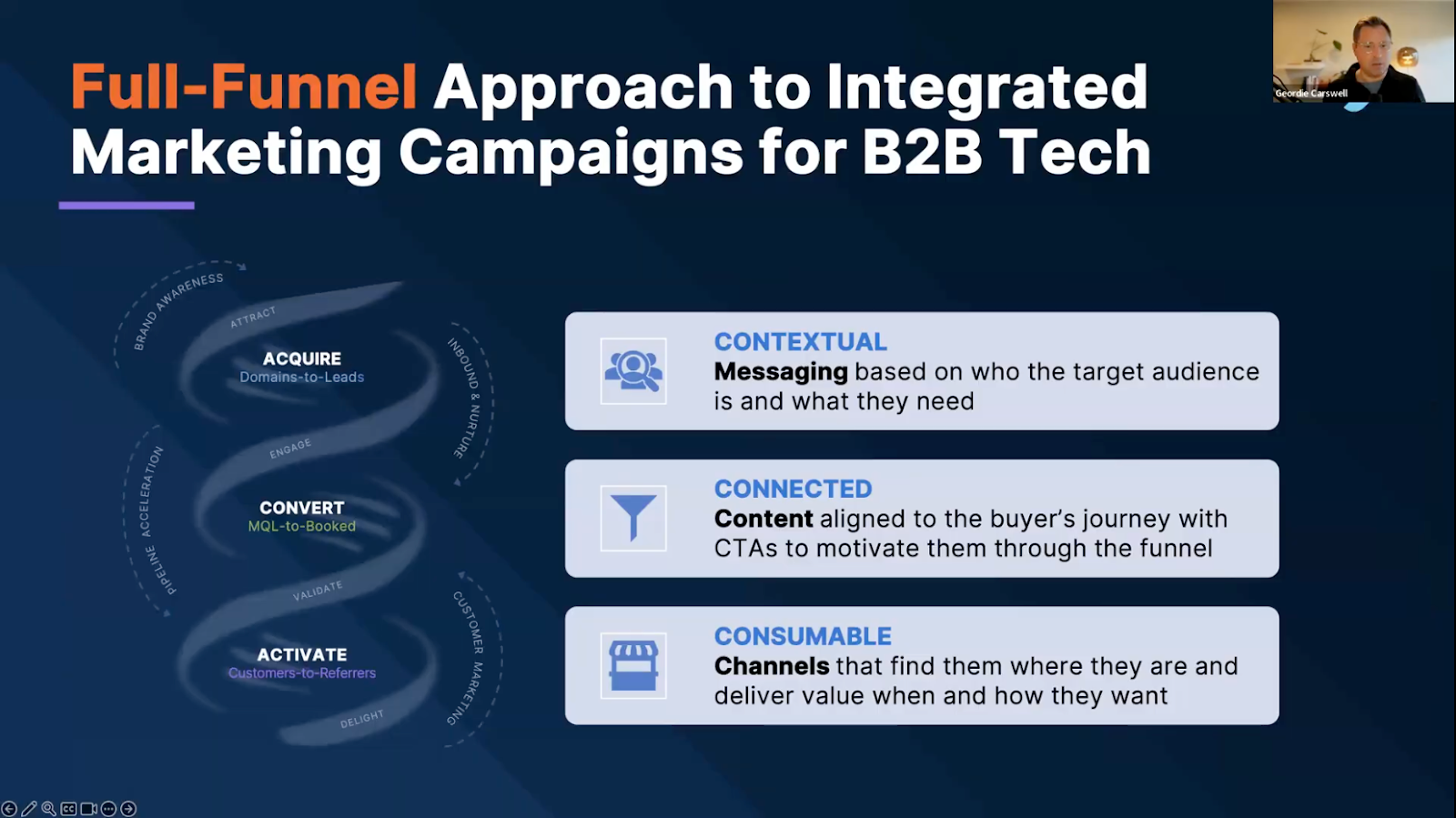
However, prospects are not always in a downward funnel motion from acquire to convert to activate. Leads do what they want. People are looking at things from their perspective in terms of what they need. This is why if you have a full-funnel approach, you think about your campaigns in terms of their perspective.
“We think about it this way it means that your integrated campaign needs to be contextual, speaking to the right audience in the right language, connected, so that you’re aligned with their current journey and designed in a way that moves them forward progressively, and then consumable, meaning that you meet them with your campaign where they’d like to be, where they like to learn, where they like to buy.”
Integrated marketing campaigns need to be so much more than we threw together some display ads along with an email and some social media for this ebook we wrote.
10 Steps to Building B2B Integrated Marketing Campaigns
Step 1: Identify a specific business goal.
This often gets overlooked in the rush to get a campaign together, but you need to have a specific business goal. Look at the funnel and understand where in the funnel your goal lies. Are you trying to increase brand awareness? Build or accelerate pipeline? Or Upsell install base or increase new paid feature adoption?
You have to figure these out at the beginning and make sure that you’re looking at this from the perspective of the business first.
Step 2: Start with the funnel state that best aligns with your business goal.
This is where you map your business goals to a specific funnel stage.
For example, brand awareness maps onto attract, building pipeline maps onto convert, and upselling install base maps onto activate/customer marketing.
Step 3. Set your campaign objective, targets, and KPIs
A goal is broad while an objective is very specific. This should be based on your funnel stage and where you should start thinking about your objective strategy including who you’re going to need help from across the organization and how you’re actually going to go about hitting your objectives.
“When it comes to KPIs and objectives, I’m just going to put a side note in here. This is where alignment and buy-in from your leadership matters when it comes to integrated campaigns.”
You can measure the success of a campaign by just what matters to you, but if those KPIs don’t matter to leadership, they won’t see the campaign as successful or repeatable. So you’ll want to sanity-check your objectives with your leadership team.
Step 4: Define your campaign strategy.
This is where you’ll need to figure out how to outline your objectives and build toward your business goal.
This example from Heather at Gigamon shares a campaign that was hyper-focused on accelerating people from stuck at the MQL phase forward. Heather was inspired to build this campaign by listening to the needs of sales and sales enablement teams and learning what is needed from the business that you can help.
Gigamon needed help getting early-stage leads moving again and then actually sales-qualified opportunities(SQOs) from that. She designed a strategy around promoting a core set of BOFU content to help with this in an integrated campaign and focused on blog posts, webinars, and video views as her Core KPIs and campaign targets of numbers of SQOs and Sales meetings.

Step 5: Specify the audience/persona.
You also need to understand who your audience is or what persona before you start building. At ActualTech, they think about these in terms of key decision-makers from the technical and business perspectives. To better understand your personas ask yourself these questions:
- What is their role?
- How can we speak to them?
- How can we reach each of them?
- What matters to each stakeholder and how are they measured?
- What do they care about? What are their pains?
- What are their objections? What might be holding them back?
In cybersecurity, how many stakeholders are typically at the decision-making table? ActualTech found that for larger companies (500+ employees), there are at least 2-5 decision-makers, so rarely is this just one person. With larger companies, these groups can be up to 6-10.
Step 6: Map the content strategy
If you have up to 10 different stakeholders, your campaign content needs to address the pain points of each of them and help them see what it is you want them to do. So you’ll need to start mapping out the content strategy.

Here’s how Heather mapped out the content strategy for the campaign we talked about earlier. Gigamon was already using the messaging of “Hey you can save lots of money with Gigamon” in other campaigns and instances, so she didn’t need to double down on this. So she wanted to connect this high-level message with the bottom-level message of “you can do this without a net new budget.”
Step 7: Pick your channels
Choose the channels where your targets are to deliver and promote the content they want to see. You need to meet your audience where they want to consume, buy, or learn.
When thinking about channels and promotion plans, you need to think about where you’re going to place this message and how you’re going to connect each step in the funnel or messaging with another.

Here, Heather wanted to ensure that each piece of core content maps to the channels where she plans to use it. You have all the standard paid channels, but you have plenty of no-cost channels like BDRs, sales, channel marketing, customers, and other influencers.
Take these sets and recycle them and that will help you execute in all of these different channels without having to reinvent the wheel every time.
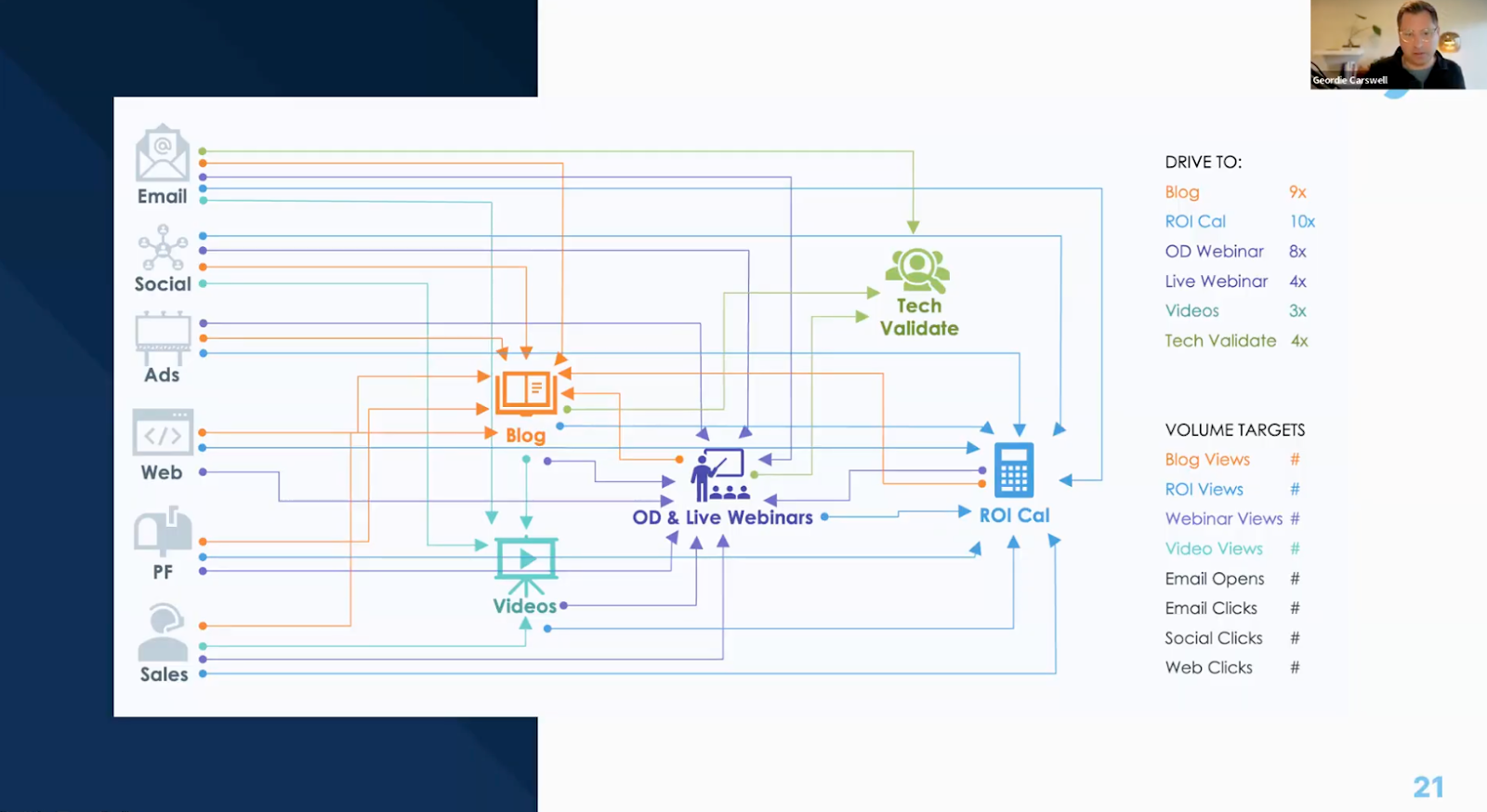
This diagram shows what it looks like when you take core assets like an email campaign, a webinar, or a blog combine them, and use them as core assets. This shows how they are recycled, reused, and measured.
Step 8: Align/Prioritize/Schedule
Across your channels and content, you’ll need to align, prioritize, and schedule based on the impact, budget, timing, resources, and effort available for your campaign.
A pro tip at this stage is to document everything as you go not just so you can get buy-in. This needs to live on more than a whiteboard and likely will take some spreadsheet work to start mapping this out.
You’ll need to look at different aspects and make sure you’re spending time on their highest priority areas first.
Step 9: Collaboration, Strategy, and Planning
Obviously, you can’t pull an integrated marketing campaign off by yourself. Giving thought to how you’re going to effectively collaborate within the organization and how you’ll get wide buy-in is important. This means having buy-in all the way through and doesn’t get lost along the way. Set your team and the cross-functional team up for success.
This also includes understanding what roadblocks there might be to success during the planning process or once the campaign is active.
One tip is to having a way of listening to sales (such as attending their QBRs or lurking in their slack channels) to make sure you have a real understanding of the objections and issues they’re running into.

An example of how to enhance collaboration is to make sure you have a complete, robust, upfront plan. Pro tip: Using existing meetings rather than creating new ones can make this process easier.
Step 10: Measure and optimize return on investment and effort.
Make sure you’re measuring and optimizing your campaign. There’s a saying “measuring to learn” so you’re not simply measuring for the sake of measuring, but rather to take lessons forward.

Here’s an example of how you can start with what you want to know and questions to ask yourself to better understand what to measure and what’s just curiosity. Measure what matters in terms of your business goal and objectives you set out at the start of the campaign but the other things that you might optimize and index for those are the things you need to make sure they’re not too noisy.
Tips:
- Don’t measure what you can’t act on
- Normalize your data
- Leverage 3rd party audiences
- Don’t forget to factor in the people's effort
Don’t Forget
Full funnel integrated marketing campaigns require..
- Contextual Messaging Hierarchy
- Content strategy
- Connected Channels
- Commitment, Collaboration, and Patience
.

.png)
.png)